Roof pitch is the first number you need on most roofing jobs. It shapes how much material you order, what goes under the shingles, and how you set up to work safely. The roof pitch calculator above handles the math. Here’s what the numbers mean and how to get a measurement worth trusting.
What Roof Pitch Means: Rise Over a 12-Inch Run
Roof pitch is how steep a roof is, written as rise over run. The rise is how far the roof climbs straight up. The run is how far it travels level. In the US, the run is fixed at 12 inches, so pitch is written as X/12. A 6/12 roof climbs 6 inches for every 12 inches of level distance.
You’ll also see it written as 6:12, or hear it called “6 in 12”. Holding the run at 12 makes pitches easy to compare: a 4/12 roof is gentle, while a 12/12 climbs a foot for every foot, which is 45 degrees.
One thing trips people up: the run is measured level, not along the roof. Measure 12 inches along the shingles and your pitch will read low. For the rest of the jobsite vocabulary, see our roofing terms guide.
How to Use the Roof Pitch Calculator
Pick the input that matches what you’ve got:
- Rise per 12 inches of run. Know the pitch, or measured over a 12-inch level? Enter the rise. Type 7 for a 7/12 roof.
- Rise and run in any unit. Enter both in the same unit, inches, feet or millimeters, and the calculator scales them to a 12-inch run. A 30-inch rise over a 60-inch run is a 6/12.
- Angle in degrees. Have a reading from an angle finder or phone app? Enter it and get the pitch back.
Whichever way you go in, you get four numbers back: pitch as X/12, angle in degrees, percent grade, and the rafter or pitch multiplier. So it doubles as a roof angle calculator and a pitch-to-degrees converter. If a measurement lands between whole pitches, check a second spot before you settle on a number.
How to Measure Roof Pitch Three Ways
All you need is a rise measured over a known, level run. Here are three ways to get it, most reliable first.
On the Roof With a Level and Tape
- Take a level at least 2 feet long and mark 12 inches from one end.
- Set that end on the roof and hold the level out toward the eave, bubble centered.
- Measure straight down from the 12-inch mark to the roof. That’s your rise. Five inches means a 5/12 roof.
Pick a flat stretch away from vents and patches, and take two readings. Only do this if you can get on the roof safely, with the right fall protection in place.
From the Attic on a Rafter
The attic gives the same answer without climbing onto the roof. Hold one end of the level against the bottom edge of a rafter or truss top chord, level it, and measure straight up from the 12-inch mark to the underside of the rafter. That’s the rise. On an ordinary framed roof, the pitch of the rafters is the pitch of the roof.
Stand on joists or solid decking, never on the ceiling between them, and bring a good light.
From the Ground With a Phone App or Pitch Gauge
Can’t get up top? Estimate from the ground. Stand square to a gable end, far enough back to see the whole rake. Hold a pitch gauge or a phone angle app so its edge lines up with the rake and read the angle, or take a straight-on photo of the gable and measure the angle in an app. Enter the angle in the calculator to get the pitch.
Treat any ground reading as an estimate. Standing off-square, lens distortion, a phone case or an uncalibrated sensor can all throw it off, and near 6/12 a single degree is worth about a quarter inch of rise per foot. Confirm on the roof or in the attic before you order materials or firm up a price.
Roof Pitch Formulas: Degrees, Percent Grade and Multiplier
Every result comes from the rise over a 12-inch run. Measured a different run? Swap it in for the 12.
- Angle in degrees = arctan(rise ÷ 12)
- Percent grade = rise ÷ 12 × 100
- Pitch multiplier = √(1 + (rise ÷ 12)²)
To go from an angle back to a pitch, the rise is 12 × tan(angle). Rather look it up? The roof pitch chart lists every pitch from 1/12 to 24/12.
What the Roof Pitch Multiplier Does
A sloped roof has more surface than the flat outline it covers, and the multiplier is the ratio between the two. Multiply the footprint, overhangs included (the plan area), by the multiplier and you have the actual roof area.
The same number turns a level run into a length along the slope, which is why it also goes by rafter multiplier. A 14-foot run on a 6/12 roof is about 15.65 feet along the slope (14 × 1.118), before any allowance for the ridge or the overhang.
Worked Example: Pitch, Degrees and Squares for a 6/12 Roof
Say you measured a 6-inch rise over 12 inches of run.
- Rise ÷ run: 6 ÷ 12 = 0.5
- Angle: arctan(0.5) = 26.57°
- Percent grade: 0.5 × 100 = 50%
- Multiplier: √(1 + 0.5²) = √1.25 = 1.118
Now the area. A 40-by-30-foot footprint, overhangs included, is 1,200 square feet of plan area. Multiply by 1.118 and you get about 1,341.6 square feet of roof. At 100 square feet per roofing square, that’s about 13.4 squares before waste, starter and ridge.
The same footprint at other pitches:
| Pitch | Angle | Grade | Multiplier | Roof area | Squares |
|---|---|---|---|---|---|
| 4/12 | 18.43° | 33.3% | 1.054 | 1,264.8 sq ft | 12.6 |
| 6/12 | 26.57° | 50% | 1.118 | 1,341.6 sq ft | 13.4 |
| 8/12 | 33.69° | 66.7% | 1.202 | 1,442.4 sq ft | 14.4 |
| 12/12 | 45.00° | 100% | 1.414 | 1,696.8 sq ft | 17.0 |
Same footprint, over four more squares at 12/12 than at 4/12. The multiplier assumes every plane shares one pitch, so if a roof mixes pitches, figure each section on its own and add them up.
Low-Slope vs Steep-Slope Roofs
Where low slope ends depends on who’s defining it, but the line is commonly drawn at about 3:12 or 4:12. Below it is low-slope roofing, which drains more slowly and typically gets a membrane system. Above it is steep-slope roofing, where shingles shed water through overlap and gravity.
Pitch also decides what goes under the shingles. Asphalt shingles generally need a minimum slope of 2:12, with double underlayment commonly required from 2:12 up to 4:12 under the International Residential Code. Local code and the manufacturer’s instructions govern, so check both before you order. A 3/12 porch and a 6/12 main roof on one house may need different underlayment.
Steep Pitches, Walkability and Safety
The calculator gives you the angle, not whether a roof is safe to walk. That’s a judgement call, and pitch is only part of it: the surface, dew or frost, loose granules, the weather, your footwear and your experience all count.
As pitch climbs, the setup changes. Steeper roofs call for fall protection and roof jacks with planks, and every task takes longer. Follow your company’s safety plan and the rules that apply to your job, and get the setup in place before anyone needs it.
How ROOFERS COFFEE Borrowed Roof Pitch for Its Roast Scale
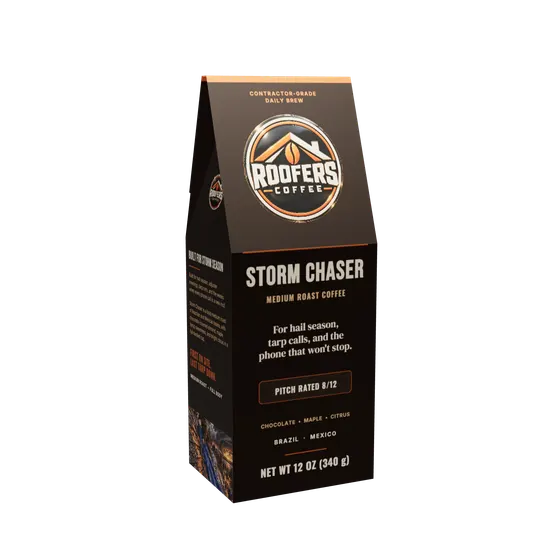
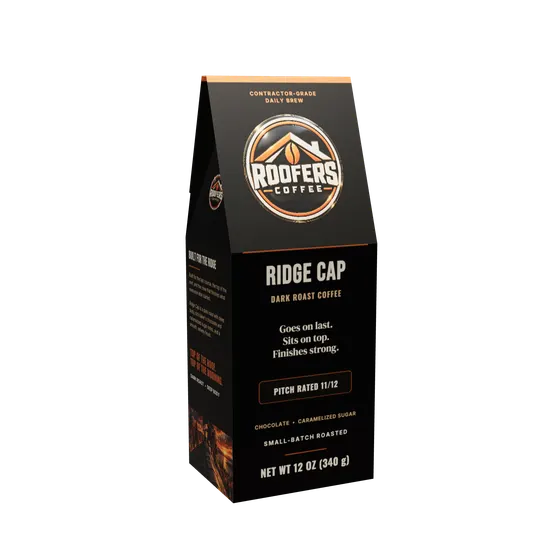
Rise over run made so much sense we named our roast scale after it. The ROOFERS COFFEE pitch rating works like roof pitch: the higher the pitch, the darker the roast and the bolder the cup. Light roasts like Skylight sit at 4/12. Storm Chaser, a medium roast, is an 8/12. The darkest, Ridge Cap, is an 11/12.
It rates roast, not slope, but the math still checks out: punch in 11/12 and you get about 42.51 degrees. Steep roof, bold cup. For more free tools, open the Roofer’s Toolbox.